




24/7 Support
Fast, professional support




















Modern IT infrastructure is no longer confined to a single server room. Businesses now operate across multiple locations, hybrid cloud environments, edge computing facilities, and high-density data centers that require constant uptime and real-time visibility. As organizations continue scaling their infrastructure, traditional server management methods are becoming increasingly inefficient.
IT administrators can no longer afford to physically travel between racks, server rooms, or remote facilities every time a system requires troubleshooting, BIOS access, maintenance, or monitoring. Downtime is costly, response times matter more than ever, and infrastructure complexity keeps growing.
This is where KVM over IP technology is transforming the industry.
KVM over IP allows IT teams to remotely access and control servers over a secure IP network, giving administrators the ability to manage systems from virtually anywhere in the world. Unlike traditional KVM switches that require local physical access, IP-based KVM systems provide centralized management, remote troubleshooting, BIOS-level control, improved scalability, and enhanced operational efficiency.
From enterprise data centers and government facilities to edge computing deployments and network operations centers, KVM over IP solutions are now playing a critical role in modern remote server management.
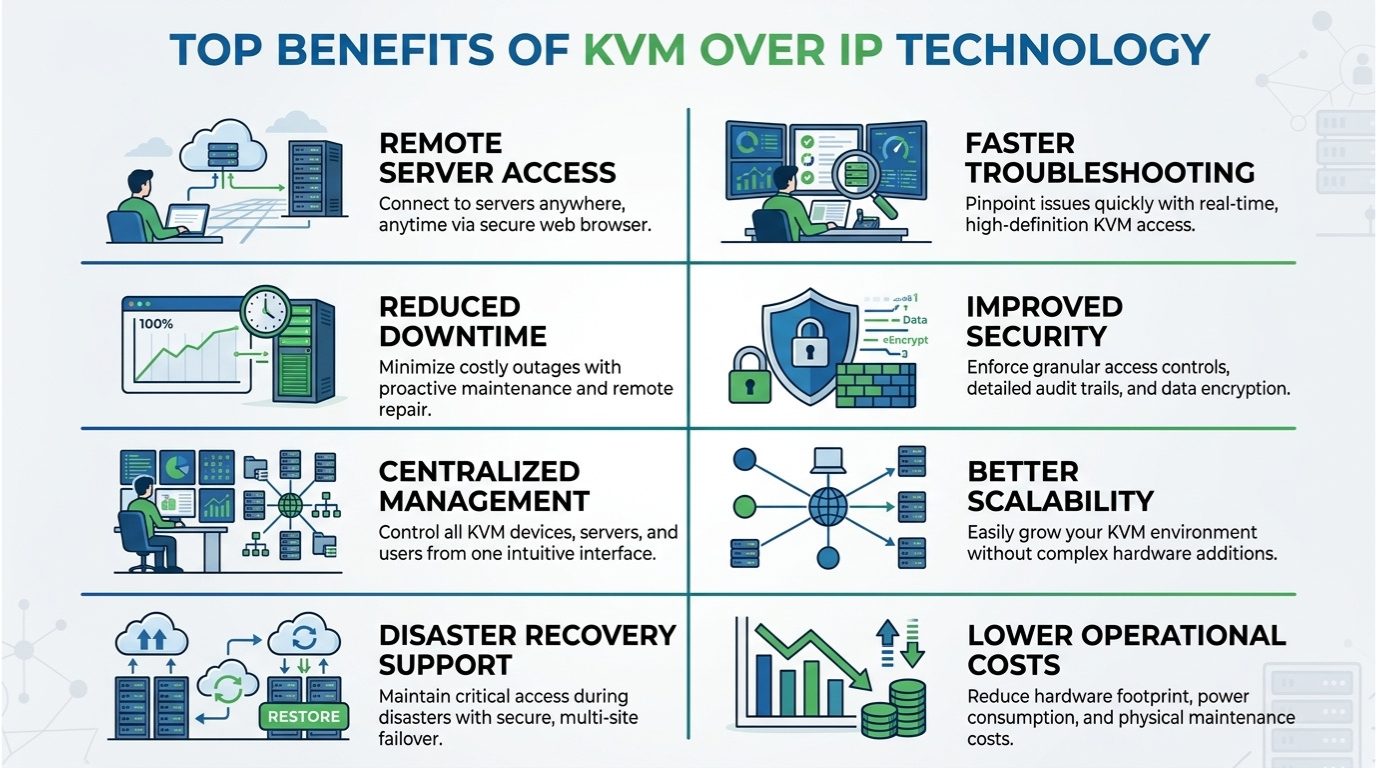
KVM over IP is a remote server management technology that allows users to control computers and servers over a network connection using a keyboard, video, and mouse interface.
The term “KVM” stands for:
Traditional KVM switches were originally designed to help administrators manage multiple servers from a single console inside a server room. While this simplified local server administration, it still required physical presence near the hardware.
KVM over IP takes this concept further by transmitting keyboard, video, and mouse signals through an IP network. This allows IT administrators to remotely access and control servers from virtually any authorized location.
In simple terms, an IP KVM switch acts like a remote bridge between the administrator and the server infrastructure.
Even if a server crashes, freezes, or loses operating system functionality, administrators can still gain BIOS-level access remotely using KVM over IP technology.
That capability has become extremely valuable for:
Before IP-based KVM solutions became mainstream, organizations relied heavily on traditional rackmount KVM switches.
These systems allowed multiple servers to connect to a single keyboard, monitor, and mouse setup.
For years, traditional KVM switches helped businesses:
However, they came with major limitations.
Administrators still needed to be physically present inside the server room to manage systems. In small environments this was manageable, but modern enterprise infrastructure is far more distributed.
Today’s organizations often manage:
Physical-only server management no longer aligns with the speed and flexibility modern IT operations require.
KVM over IP technology works by converting keyboard, video, and mouse signals into digital data that can travel securely across an IP network.
Here’s a simplified breakdown of the process:
This creates a fully interactive remote management environment that behaves almost like sitting directly in front of the server.
One of the biggest advantages of KVM over IP is out-of-band management.
Unlike software-based remote desktop tools that rely on the operating system being active, KVM over IP operates independently from the server OS.
That means administrators can:
This level of control is critical for enterprise server management.
A modern KVM over IP setup typically includes several components working together to deliver secure remote access.
|
Component |
Function |
|
KVM Over IP Switch |
Connects and manages multiple servers remotely |
|
Rackmount Console |
Provides local rack access when needed |
|
Network Connection |
Transmits remote keyboard, video, and mouse signals |
|
Authentication System |
Controls secure user access |
|
Remote User Interface |
Allows administrators to manage servers remotely |
|
Cabling Infrastructure |
Connects servers and network hardware |
Some advanced enterprise KVM systems also support:
These capabilities make modern IP KVM systems significantly more powerful than traditional server access methods.
The way businesses manage infrastructure has changed dramatically over the last decade.
Organizations are now operating larger and more distributed environments than ever before. At the same time, expectations for uptime, performance, and security continue rising.
Traditional server management methods that rely heavily on physical access are struggling to keep up.
For modern IT teams, physically visiting server rooms to diagnose issues, reboot systems, or perform maintenance creates operational inefficiencies that can slow response times and increase downtime risks.
As infrastructure scales, these inefficiencies become even more noticeable.
Modern enterprise infrastructure often includes:
Managing all these systems manually is time-consuming and resource-intensive.
IT teams are expected to monitor infrastructure continuously while maintaining rapid response times for incidents and outages.
Without remote server management tools like KVM over IP, organizations face major operational bottlenecks.
Physical access requirements can delay issue resolution, especially when servers are located in remote facilities.
Every minute spent waiting for on-site access can increase service disruptions and operational losses.
Traditional server environments often lack centralized management and real-time monitoring capabilities.
Travel, staffing, and on-site maintenance requirements can significantly increase infrastructure management costs.
Managing larger server environments manually becomes increasingly difficult as infrastructure expands.
Highly skilled IT personnel may spend excessive time performing routine physical maintenance tasks.
These challenges are one of the main reasons why businesses are rapidly adopting KVM over IP solutions.
KVM over IP technology is fundamentally changing how organizations manage, monitor, and maintain server infrastructure.
Instead of relying on physical proximity to hardware, IT administrators can now securely control systems remotely with full keyboard, video, and mouse functionality.
This transformation is improving:
For enterprise organizations, this shift represents a major advancement in remote infrastructure operations.
One of the biggest advantages of KVM over IP is instant remote accessibility.
Administrators can securely access servers from virtually anywhere using a web interface or centralized management platform.
This allows IT teams to:
In modern enterprise environments where uptime is critical, real-time accessibility can dramatically reduce operational delays.
Unlike traditional remote desktop applications, KVM over IP provides BIOS-level access.
This is one of the most important features for enterprise IT teams.
Even if:
Administrators can still remotely interact with the system.
This capability improves troubleshooting efficiency and reduces the need for physical intervention.
Downtime remains one of the biggest threats to enterprise operations.
KVM over IP allows administrators to respond to issues immediately without waiting for on-site access.
Instead of dispatching technicians to remote facilities, IT teams can:
This helps organizations minimize disruption and maintain higher infrastructure availability.
As organizations scale, centralized control becomes increasingly important.
KVM over IP solutions allow administrators to manage multiple racks, server rooms, and facilities from a single interface.
This centralized visibility simplifies:
Centralized management also improves operational consistency across enterprise environments.
As enterprise IT environments continue growing in complexity, organizations are under increasing pressure to improve uptime, reduce operational costs, strengthen security, and maintain full visibility across distributed infrastructure.
This is where KVM over IP solutions provide a major competitive advantage.
Unlike traditional server management methods, KVM over IP technology allows organizations to create a more scalable, flexible, and efficient infrastructure management strategy.
From enterprise data centers and telecom facilities to government operations and edge computing deployments, businesses are using IP KVM systems to simplify server administration and improve operational performance.
One of the biggest advantages of KVM over IP is the reduction in operational expenses.
Traditional server management often requires:
These operational requirements increase infrastructure costs over time.
KVM over IP minimizes many of these expenses by allowing administrators to remotely manage systems from a centralized location.
This reduces:
For enterprises operating multiple facilities or remote branch offices, the savings can be significant.
Speed is critical when managing mission-critical infrastructure.
Even small delays during outages can affect:
KVM over IP helps organizations respond to incidents faster by enabling real-time remote access.
Instead of waiting for technicians to arrive on-site, administrators can immediately:
This dramatically improves response times during critical infrastructure incidents.
Modern businesses rely heavily on infrastructure availability.
Downtime in enterprise environments can impact:
KVM over IP solutions help improve uptime by giving administrators instant visibility into server infrastructure.
Remote BIOS-level access allows teams to troubleshoot systems before outages escalate into larger operational disruptions.
The ability to perform immediate remote recovery operations is one of the main reasons why IP KVM technology has become essential in enterprise data centers.
Without centralized management tools, highly skilled IT staff often spend excessive time performing routine physical maintenance tasks.
KVM over IP improves efficiency by reducing the need for manual server interaction.
This allows IT departments to focus more on:
By minimizing repetitive operational tasks, organizations can use technical resources more effectively.
Modern enterprises often operate infrastructure across:
Managing these environments individually creates operational complexity.
KVM over IP provides centralized visibility that allows administrators to manage multiple systems from a unified platform.
This simplifies:
Centralized management also improves operational consistency across enterprise environments.
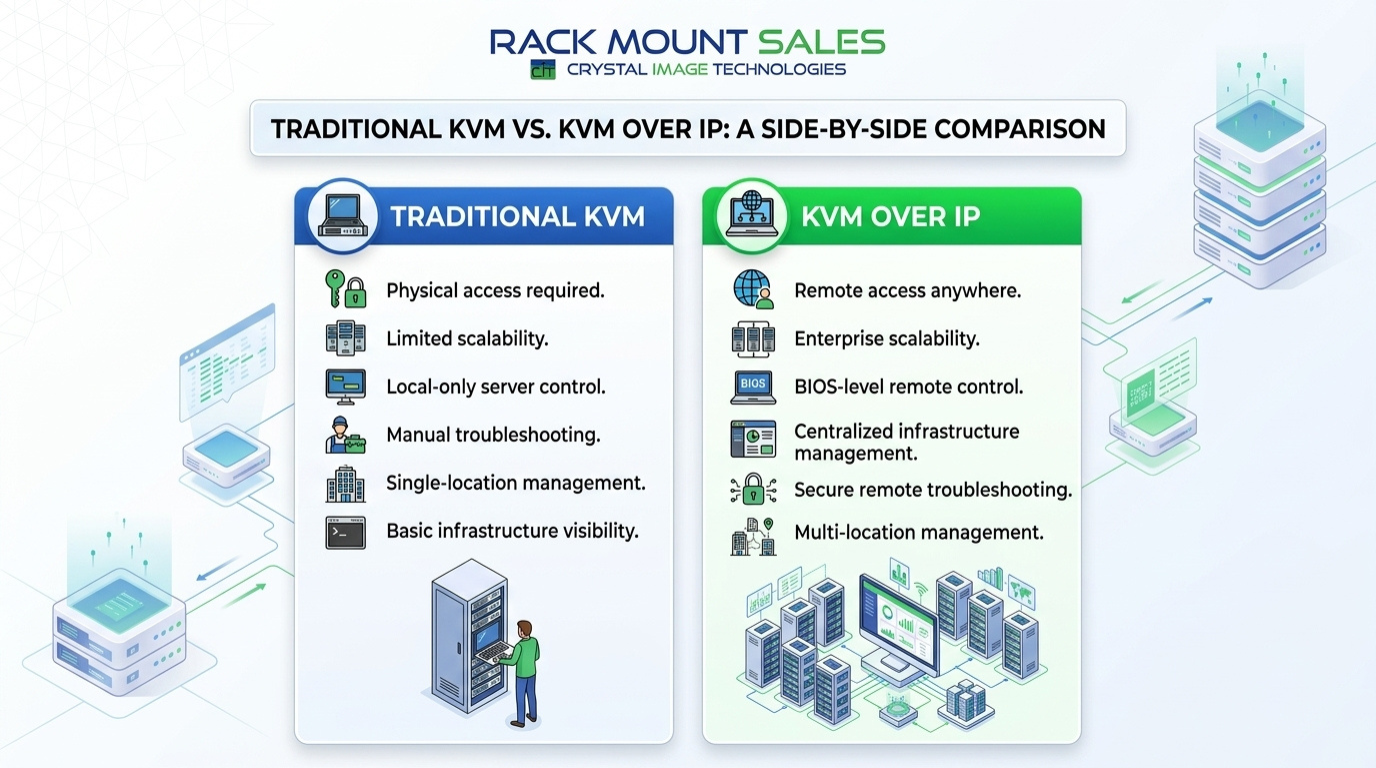
While traditional KVM switches still play a role in some server environments, modern enterprise infrastructure increasingly requires the flexibility and scalability of KVM over IP.
The differences between the two technologies become more noticeable as organizations expand their infrastructure.
Traditional KVM systems are primarily designed for local server management.
Administrators connect multiple servers to a single console setup consisting of:
These systems help reduce hardware clutter and improve rack organization, but they require physical access to the server environment.
Traditional KVM switches work well for:
However, they become less practical in distributed enterprise operations.
KVM over IP extends server management capabilities beyond physical server rooms.
By transmitting keyboard, video, and mouse signals across IP networks, administrators gain secure remote access to infrastructure from virtually anywhere.
This provides significant advantages for:
|
Feature |
Traditional KVM |
KVM Over IP |
|
Remote access |
Limited |
Full remote access |
|
BIOS-level control |
Local only |
Remote BIOS access |
|
Scalability |
Moderate |
Enterprise-level scalability |
|
Multi-site management |
Difficult |
Centralized management |
|
Disaster recovery |
Limited |
Strong remote recovery capabilities |
|
Security features |
Basic |
Advanced authentication and encryption |
|
Infrastructure visibility |
Localized |
Centralized monitoring |
|
Operational efficiency |
Moderate |
High |
|
Remote troubleshooting |
No |
Yes |
|
Enterprise readiness |
Limited |
Excellent |
Organizations should consider upgrading when they:
As infrastructure complexity grows, traditional server management methods become increasingly difficult to maintain efficiently.
Security is one of the most important considerations in remote server management.
Because KVM over IP systems provide remote access to critical infrastructure, modern solutions include advanced security features designed to protect enterprise environments from unauthorized access and cyber threats.
This is especially important for:
Modern IP KVM systems are designed with enterprise-grade security controls that support both operational flexibility and infrastructure protection.
Strong authentication mechanisms help ensure that only authorized personnel can access infrastructure.
Many enterprise KVM over IP solutions support:
These controls improve infrastructure security while simplifying enterprise user management.
Because keyboard, video, and mouse signals travel across IP networks, encryption is essential.
Modern KVM over IP switches commonly support:
This helps protect sensitive operational data from interception or unauthorized monitoring.
Not every administrator requires full infrastructure access.
Role-based access control allows organizations to assign permissions based on operational responsibilities.
For example:
|
User Role |
Access Level |
|
Network Administrator |
Full infrastructure control |
|
Support Technician |
Limited troubleshooting access |
|
Security Team |
Monitoring and audit access |
|
Operations Manager |
Read-only visibility |
This reduces internal security risks while improving accountability.
Many enterprise KVM systems include detailed audit logging features.
These logs help organizations:
Audit visibility is especially important in highly regulated industries.
One of the most powerful features of KVM over IP is remote BIOS-level management.
However, this level of access also requires strong security protections.
Modern systems help secure BIOS-level operations through:
This ensures organizations maintain operational flexibility without compromising security.
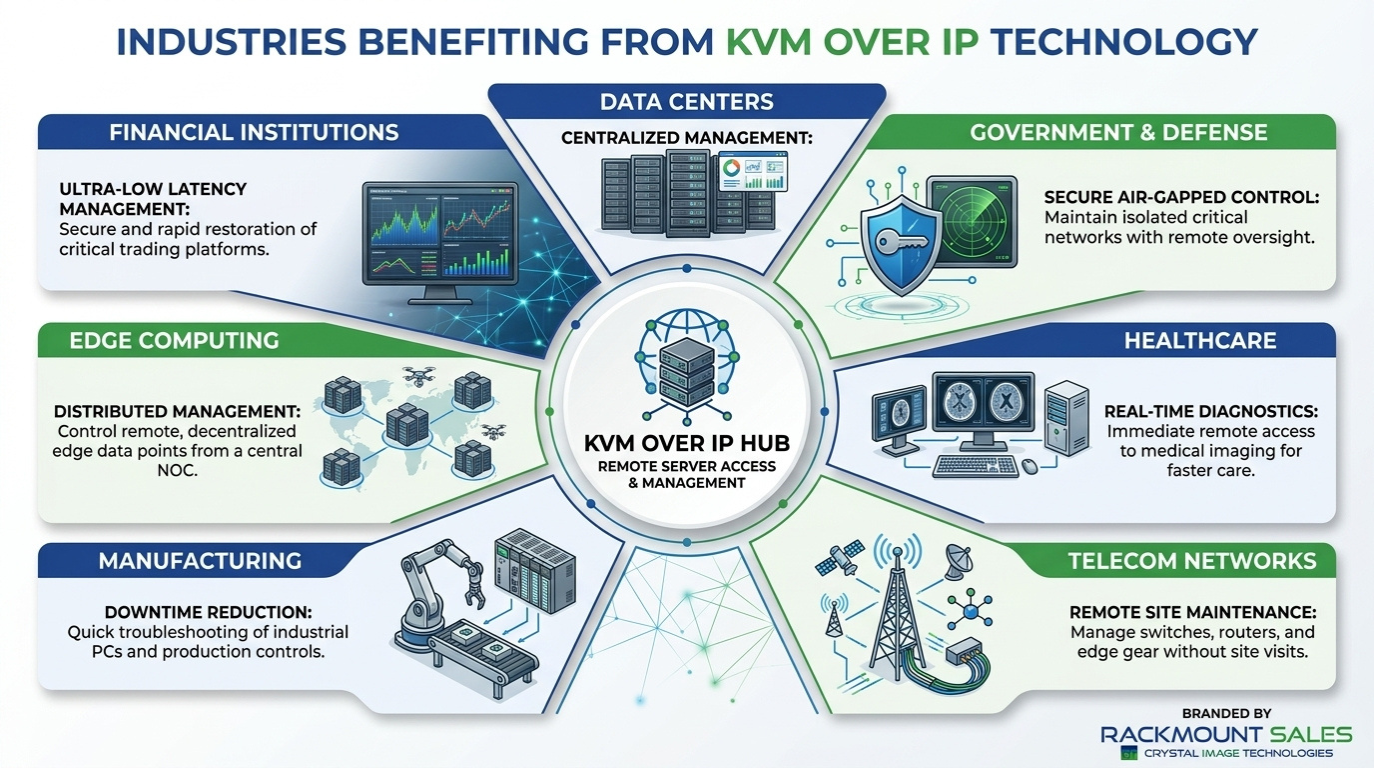
KVM over IP solutions are now used across a wide range of industries that require secure, scalable, and reliable infrastructure management.
As digital operations continue expanding, remote server management has become essential in both enterprise and mission-critical environments.
Modern data centers rely heavily on KVM over IP for:
High-density server environments require scalable management tools that minimize operational complexity.
Government agencies and defense organizations often require:
KVM over IP technology supports these requirements through secure access controls and enterprise-grade security features.
Healthcare systems rely on continuous infrastructure availability for:
Remote server management helps healthcare IT teams maintain uptime and respond quickly to infrastructure issues.
Telecommunications providers often manage infrastructure across large geographic regions.
KVM over IP allows telecom organizations to:
This improves operational efficiency across distributed network environments.
Industrial operations increasingly depend on connected infrastructure and automation systems.
KVM over IP helps manufacturing facilities manage:
Remote access capabilities improve operational continuity while reducing maintenance delays.
Edge computing infrastructure is often deployed in remote or difficult-to-access locations.
KVM over IP allows administrators to remotely manage these systems without requiring constant on-site presence.
This is becoming increasingly important as organizations expand edge infrastructure deployments.
Choosing the right KVM over IP solution is critical for building a reliable, scalable, and secure remote server management environment.
Not all KVM systems are designed for the same infrastructure requirements. Enterprise data centers, industrial facilities, government environments, and edge computing deployments often require different capabilities depending on workload demands, security policies, and operational scale.
Before investing in a KVM over IP infrastructure, organizations should carefully evaluate both current operational needs and future growth requirements.
One of the first considerations is determining how many systems need to be managed.
Organizations should evaluate:
Smaller server rooms may only require an 8 port KVM switch or compact rackmount KVM solution.
Larger enterprise environments often benefit from:
Choosing a scalable platform helps organizations avoid infrastructure limitations as operations grow.
Remote accessibility is one of the biggest advantages of KVM over IP.
However, remote management capabilities can vary significantly between systems.
Businesses should evaluate:
Advanced remote access features can improve troubleshooting speed and simplify infrastructure administration.
Video clarity is important when remotely managing servers and network infrastructure.
Low-quality video output can make troubleshooting difficult, especially in high-density environments.
Modern KVM over IP systems often support:
Organizations managing complex infrastructure should prioritize systems with strong video performance.
Security should never be treated as an afterthought.
Since KVM over IP provides direct remote access to critical systems, organizations should prioritize enterprise-grade security features.
Important security capabilities include:
Highly regulated industries such as government, healthcare, and finance often require advanced security compliance standards.
Organizations should also evaluate physical deployment requirements.
Rackmount KVM systems should integrate smoothly into existing infrastructure.
Important considerations include:
|
Deployment Factor |
Why It Matters |
|
Rack size compatibility |
Ensures proper installation |
|
Cable management support |
Reduces infrastructure clutter |
|
Power redundancy |
Improves uptime protection |
|
Cooling efficiency |
Prevents overheating |
|
Space optimization |
Maximizes rack utilization |
Efficient rack integration improves both operational reliability and long-term infrastructure organization.
Modern enterprise environments often rely on multiple management platforms.
A good KVM over IP solution should integrate easily with:
Strong integration capabilities simplify deployment and improve overall infrastructure visibility.
KVM over IP is used for remote server management. It allows administrators to remotely access and control servers over a network using keyboard, video, and mouse functionality.
A KVM over IP switch converts keyboard, video, and mouse signals into digital data that can be transmitted securely across an IP network for remote access.
Modern KVM over IP systems support advanced security features such as encryption, multi-factor authentication, secure user access controls, and audit logging.
Traditional KVM systems require physical access to servers, while KVM over IP allows remote access and management over a network.
Yes. One of the biggest advantages of KVM over IP is remote BIOS-level access, which allows administrators to manage systems even if the operating system fails.
Yes. Enterprise data centers widely use KVM over IP solutions for centralized server management, remote troubleshooting, and infrastructure monitoring.
Industries including healthcare, government, telecom, manufacturing, defense, and enterprise data centers benefit heavily from remote KVM infrastructure.
Many enterprise-grade KVM over IP solutions support multiple simultaneous users with role-based access permissions.
Yes. KVM over IP is highly valuable for edge computing because it enables remote management of distributed infrastructure.
Organizations should evaluate scalability, security, remote access capabilities, rack compatibility, video quality, and integration support before selecting a KVM over IP system.
Remote infrastructure management is becoming one of the most important components of modern IT operations.
As enterprise environments continue expanding across data centers, edge computing deployments, hybrid cloud infrastructure, and remote facilities, traditional server management methods are no longer sufficient.
KVM over IP technology provides organizations with the flexibility, scalability, and centralized control needed to manage modern infrastructure efficiently.
From faster troubleshooting and improved uptime to stronger security and remote BIOS-level access, KVM over IP solutions are transforming how businesses operate and maintain mission-critical systems.
Whether you are upgrading a data center, expanding edge infrastructure, improving disaster recovery operations, or optimizing server room efficiency, choosing the right KVM over IP solution can significantly improve operational performance.
At Rackmountsales, businesses can explore professional-grade rackmount KVM switches, rack mount monitors with KVM switch systems, LCD monitor drawers, industrial display solutions, and enterprise infrastructure products designed for modern IT environments.
As remote infrastructure management continues evolving, KVM over IP will remain a critical technology for organizations seeking greater control, visibility, security, and operational efficiency.

Industrial LCD displays are built for heavy-duty environments like factories, warehouses, and outdoor terminals. They can handle heat, dust, vibration, and long operating hours.
Militarydev411

Downtime costs more than most people expect. When LCD monitor drawers fail inside a rack, teams lose access, waste time, and risk bigger hardware issues. Proper care keeps LCD monitordev411

A rack mount monitor with KVM combines display, keyboard, and mouse into a single unit. This all-in-one design lets IT teams access multiple servers without juggling separate devices.dev411










We are so confident you will be satisfied with our products that we offer a 100% satisfaction guarantee


