




24/7 Support
Fast, professional support




















Most IT buyers shopping for a rackmount monitor focus on screen size and resolution. Few think about chassis depth until the drawer doesn't fit. A standard rackmount console drawer can run anywhere from 22 to 30 inches deep. If your rack is only 18 or 20 inches from front to back, that standard unit physically cannot be installed. That's where short-depth rackmount monitors come in.
These are not niche products. They solve a real, common problem that shows up in server rooms, transit cases, vehicles, wall-mount enclosures, and anywhere else space is genuinely limited. If you've never heard the term before, this guide will tell you exactly what it means, how it differs from a standard unit, and, most importantly, whether your environment actually needs one.
A short-depth 1U rackmount monitor is a 1U LCD console drawer designed with a reduced front-to-back chassis measurement, typically between 15 and 20 inches, compared to 22 to 30 inches for standard units. That difference in depth is the entire point of the product.
Everything else, the flip-up display, the integrated keyboard, the slide-out tray mechanism, works the same as a standard rackmount console drawer. The only meaningful difference is how far back into the rack the chassis extends when installed. This allows it to fit inside enclosures that would reject a standard-depth unit outright.
You'll also see these called shallow-depth rackmount monitors or shallow-depth LCD drawers. All three terms describe the same product. The defining spec to look for is the chassis depth measurement in the product listing; if it's under 20 inches, it's a short-depth unit.
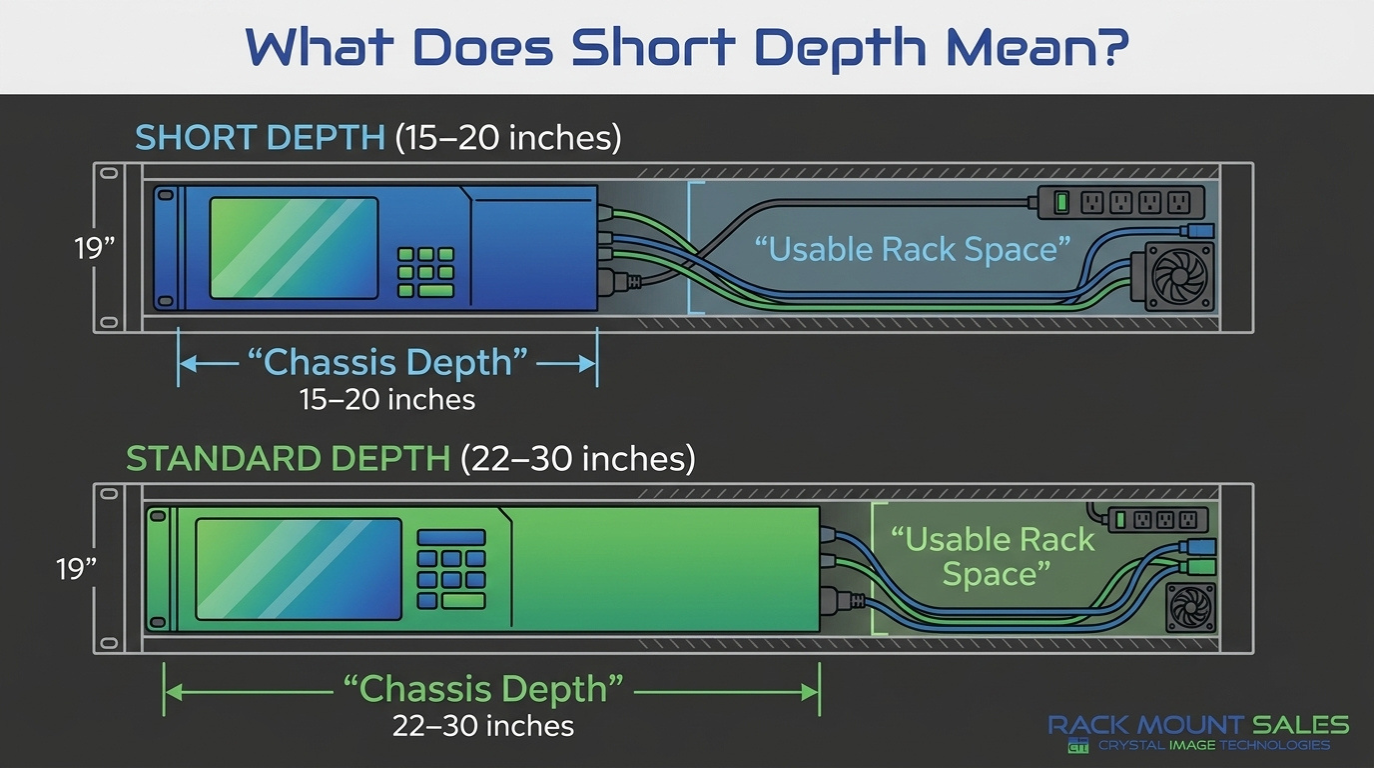
Here's how the two compare across the specs that matter most when choosing for your environment:
|
Spec |
Short-Depth Monitor |
Standard-Depth Monitor |
|
Chassis depth |
15–20 inches (380–510 mm) |
22–30 inches (560–760 mm) |
|
Minimum rack depth needed |
~16 inches |
~24 inches |
|
Rack form factor |
1U (standard) |
1U or 2U |
|
Screen sizes available |
17" and 19" typical |
17", 19", 21"+ |
|
Transit case compatible |
Yes |
No |
|
Vehicle rack compatible |
Yes |
Often no |
|
Wall-mount enclosure fit |
Yes |
Often no |
|
Weight |
Lighter |
Heavier |
|
Typical cost premium |
10–20% higher |
Baseline |
|
Availability |
More specialized |
Widely available |
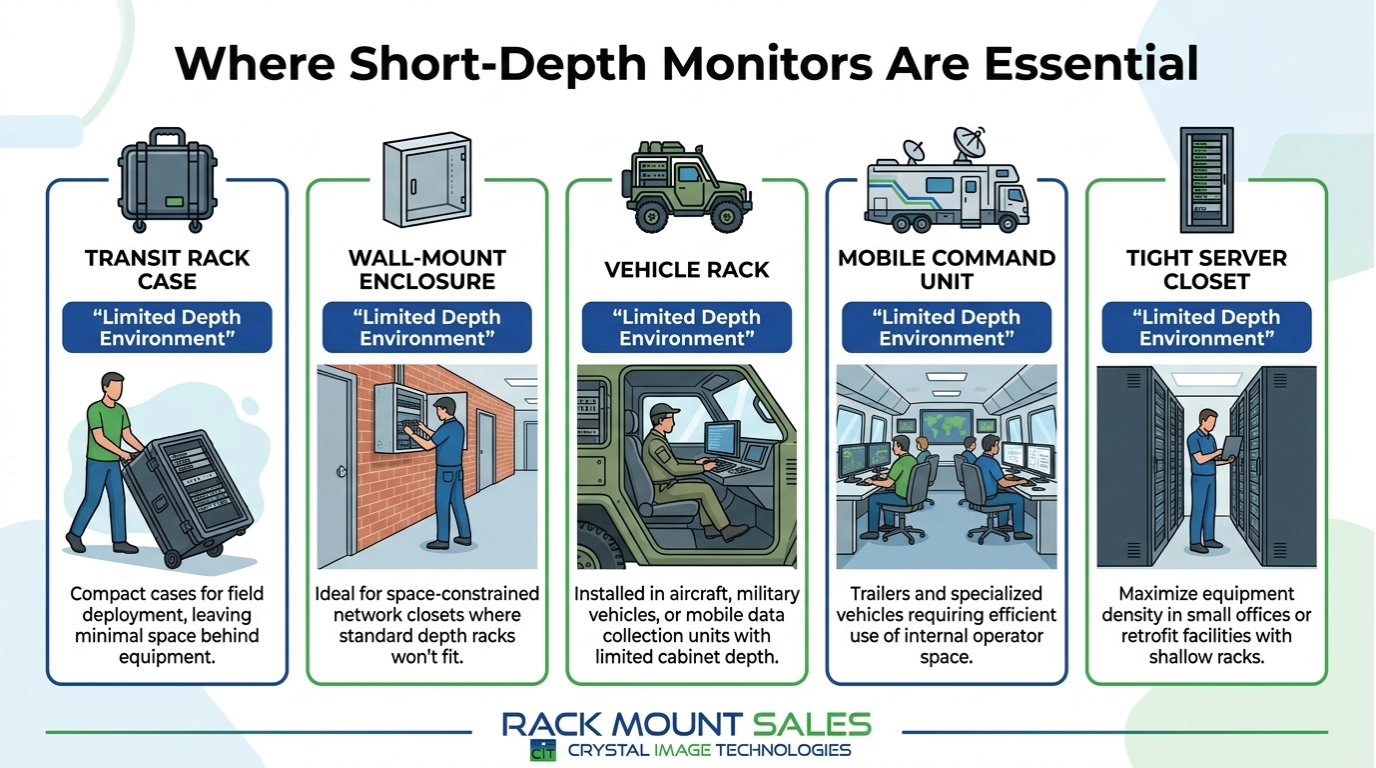
Short-depth rackmount monitors are not a general preference, they solve specific physical constraints. Here are the environments where you need one, not just want one.
A transit rack case is a portable, ruggedized enclosure designed to transport equipment between locations, job sites, events, broadcast trucks, field deployments. These cases are built to ATA-300 or MIL-STD-810 standards and are deliberately compact to remain carryable or truck-loadable.
The internal depth of a transit case is almost always under 20 inches. A standard 26-inch KVM drawer won't fit inside one at all. A short-depth unit with an 18- or 19-inch chassis installs cleanly, closes the case lid, and survives the transport. This is the most common reason organizations buy short-depth rackmount monitors.
Wall-mount server enclosures, common in small server rooms, network closets, retail back-offices, and healthcare facilities, typically run between 16 and 20 inches deep. That's enough for switches, patch panels, and 1U servers, but not enough for a standard-depth LCD drawer.
Short-depth rackmount monitors were designed with these installations in mind. They slide into wall enclosures cleanly without protruding past the cabinet frame or preventing the door from closing.
Military vehicles, emergency response units, broadcast trucks, and mobile command centers all use 19-inch rack systems built into the vehicle. The mounting cavity is fixed, often 16 to 20 inches front-to-back, and cannot be modified after installation.
Short-depth LCD drawers are specifically designed for these deployments. Many units built for vehicle use also include DC power input (12V, 24V, 48V) and reinforced slide mechanisms to handle vibration and shock loads, making them a natural fit for the rugged mobile applications common in defense and emergency services.
Some data centers and server closets use open-frame two-post racks rather than four-post enclosed cabinets. These racks often have shorter effective depth due to cable management panels, wall proximity, or facility constraints. In these setups, a short-depth monitor may be the only option that fits without protruding past the rear of the rack.
When racks are installed back-to-back in a data center aisle, rear cable trays and containment panels often reduce usable internal depth by several inches. If a standard LCD drawer would conflict with rear-mounted PDUs or cable management, a short-depth unit resolves the clearance problem without relocating infrastructure.
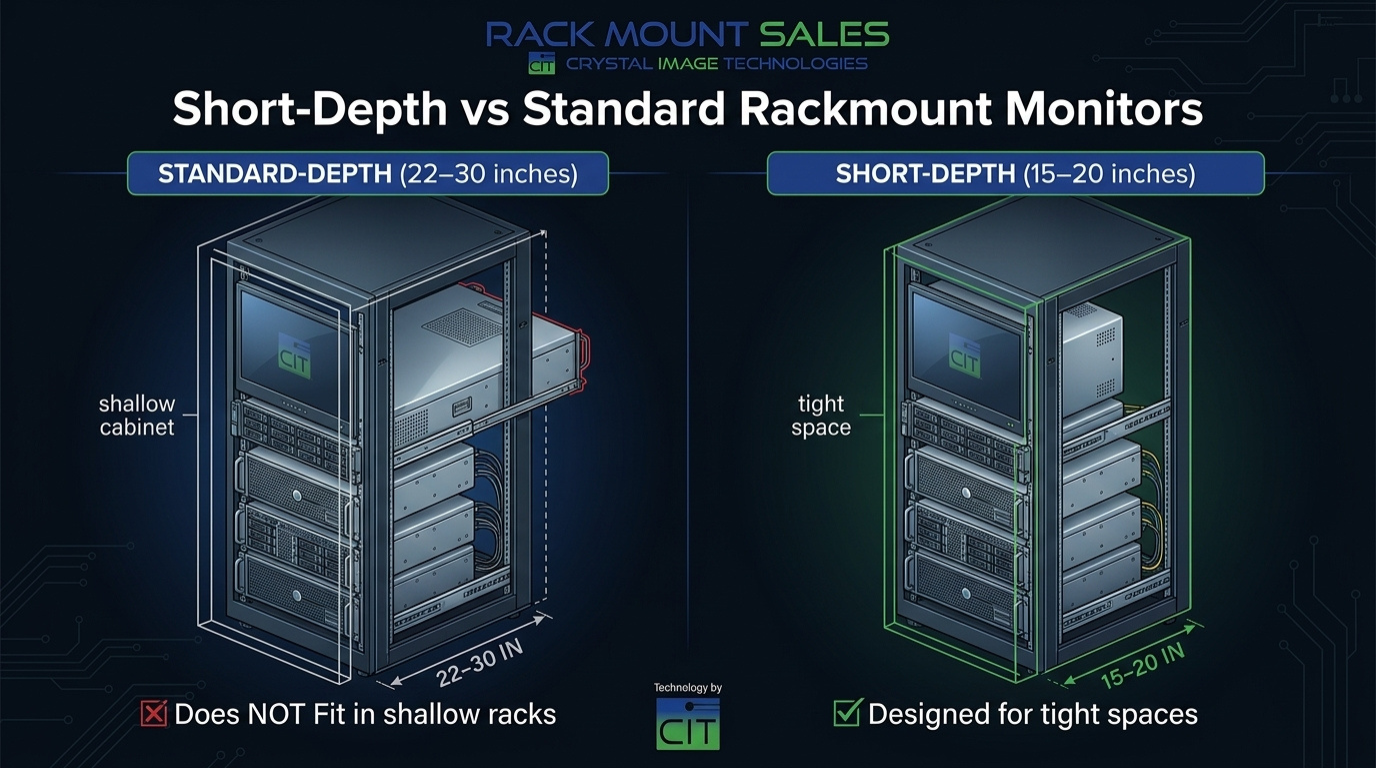
If your four-post rack is 24 inches or deeper and it's installed in a fixed server room with no mobility or space constraints, a standard-depth rackmount monitor is the right choice. Standard units are more widely available, typically cost less per unit, and come in a wider range of screen sizes and feature sets.
Buying short-depth when you don't need it means paying a small premium for a feature that serves no purpose in your environment. Measure your rack's usable internal depth before spec'ing your console drawer, that single measurement tells you which product category applies to your situation.
How to measure: Open your rack and measure from the inside face of the front mounting rails to the inside face of the rear rails (or rear cable management panel, whichever is closer). If that number is under 22 inches, you're in short-depth territory.
Once you've confirmed you need a short-depth unit, here are the specs that matter most in your purchasing decision:
|
Spec |
What to look for |
Why it matters |
|
Chassis depth |
15.7"–19" (398–483 mm) |
Must fit your rack's usable internal depth with clearance |
|
Mounting depth range |
Adjustable (e.g. 15.7"–23.7") |
Accommodates variation in rack rail spacing |
|
Screen resolution |
1920x1080 minimum |
Full HD is standard; avoid 1280x1024 panels in new purchases |
|
Video inputs |
HDMI + VGA at minimum |
Match to your server outputs; DisplayPort is a bonus |
|
Power input |
AC + optional DC (12V/24V/48V) |
DC input is essential for vehicle and military deployments |
|
Panel MTBF |
50,000+ hours |
Industrial-grade panels outlast consumer-grade in 24/7 use |
|
Keyboard type |
Interchangeable / field replaceable |
Keyboards wear out first, field replaceability reduces downtime |
|
Lock mechanism |
Two-point front lock |
Prevents accidental opening in mobile or vibration-prone environments |
Use this table to match your specific environment to the right product category before you buy:
|
Your environment |
Recommendation |
Reason |
|
Transit or portable rack case |
Short-depth |
Case depth almost always under 20 inches |
|
Wall-mount server enclosure |
Short-depth |
Shallow cabinet depth; door clearance required |
|
Vehicle or mobile rack |
Short-depth |
Fixed cavity; often requires DC power option too |
|
Fixed 4-post rack, 24"+ depth |
Standard depth |
No constraint; standard units cost less and offer more options |
|
Open-frame 2-post rack |
Short-depth |
Rear clearance often limited by wall or cabling |
|
Back-to-back data center aisles |
Measure first |
Depends on rear clearance after cable trays and PDUs |
|
Military / defense deployment |
Short-depth + DC power |
Vehicle racks and transit cases require both specs |
A short-depth rackmount monitor is a straightforward solution to a physical constraint, nothing more, nothing less. If your rack, case, or enclosure runs under 22 inches deep, a standard console drawer won't fit, and a short-depth unit is not an optional upgrade, but the only practical choice. For transit case deployments, vehicle racks, wall-mount enclosures, and mobile command setups, these units are standard equipment. For fixed, deep four-post racks in traditional data centers, a standard-depth monitor is the better buy. The right answer always starts with one measurement: how deep is your rack? Everything else follows from there. RackMountSales.com stocks a range of short-depth 1U LCD drawers in 17-inch and 19-inch configurations, including units with DC power input for mobile and rugged deployments, giving you a practical starting point once you know your rack's usable depth.
Most short-depth rackmount monitors have a chassis depth of between 15.7 and 19 inches (approximately 400–483 mm). Some units have an adjustable mounting range, for example, 15.7 to 23.7 inches, which gives flexibility across racks with slightly different rail spacing. Always compare the product's chassis depth to your rack's usable internal depth before purchasing.
Yes. A short-depth unit will install and function correctly in a full-depth rack, it simply won't extend as far back. There's no performance penalty for using a short-depth unit in a deeper rack. However, you'll pay a slight cost premium without getting any functional benefit, so a standard-depth unit is the better value choice if your rack can accommodate it.
Nothing, the terms are interchangeable. Different manufacturers use different terminology for the same product category: short-depth, shallow-depth, and ultra-short-depth all refer to LCD console drawers with reduced front-to-back chassis measurements designed for space-constrained rack environments.
Yes. Short-depth LCD drawers connect to KVM switches the same way standard units do, via HDMI, VGA, or Cat5, depending on the KVM switch model. There's no compatibility issue related to chassis depth. The depth spec only affects whether the unit fits your rack, not how it integrates with your KVM infrastructure.
Because the environments that require short chassis depths, vehicle racks, transit cases, mobile command units, and military deployments frequently run on DC power rather than standard AC. DC power inputs at 12V, 24V, and 48V allow the monitor to integrate directly with a vehicle's electrical system or a field power distribution unit without requiring an AC inverter, which adds weight, cost, and a potential failure point.
The most common screen sizes in short-depth configurations are 17 inches and 19 inches. The compact chassis constrains how large a display can be folded into the drawer mechanism, which is why larger screen sizes (21 inches and above) are rare or unavailable in short-depth form factors. For environments that need larger displays, a standard-depth drawer or a separate rackmount monitor shelf may be necessary.

Industrial LCD displays are built for heavy-duty environments like factories, warehouses, and outdoor terminals. They can handle heat, dust, vibration, and long operating hours.
Militarydev411

Downtime costs more than most people expect. When LCD monitor drawers fail inside a rack, teams lose access, waste time, and risk bigger hardware issues. Proper care keeps LCD monitordev411

A rack mount monitor with KVM combines display, keyboard, and mouse into a single unit. This all-in-one design lets IT teams access multiple servers without juggling separate devices.dev411










We are so confident you will be satisfied with our products that we offer a 100% satisfaction guarantee


